
Okay, let’s be real for a second. Can we talk about how premium subscriptions have become the new utility bill? Paying $20/month for an AI assistant and another $15 for ad-free music and videos feels less like a luxury and more like paying for electricity. As a senior who’s been improving my budget for four years, it drives me crazy that these tools, essential for any modern learner, are locked behind a full-price paywall the second you graduate. The whole concept of a student discount is great, until it vanishes the moment you get your diploma, leaving you with a massive price hike for the exact same services. It feels arbitrary and, honestly, a little insulting.
My Journey Down the “Student Discount Without.edu” Rabbit Hole
My skepticism started last semester. I saw friends who had just graduated scrambling, suddenly facing a combined bill of over $500 a year for things like Spotify, YouTube Premium, and the AI tools they’d come to rely on. My first thought was, there has to be a way around this. So, like any resourceful (and slightly broke) student, I went digging. My search history was a masterclass in desperation: “sheerid bypass,” “get student discount without being student,” “how to verify student status after graduation.”
I’ll admit, it felt… shady. Like I was trying to find a way to sneak into a digital movie theater. Most of what I found involved sketchy forums, questionable software, or asking freshmen for their login details. None of it felt right, and the risk of getting an account banned seemed high. I was about to give up, assuming the system was unbeatable. But then I stumbled upon a different concept fully: companies actually plan for this.
⚡ What is Student Discount ‘Leakage’?
Student discount ‘leakage’ is an industry term for the portion of educational discounts that go to users who may not be currently enrolled students. Major companies like Google and Spotify see this not as theft, but as a calculated marketing expense. They budget for a certain amount of leakage because getting a long-term user at a discounted rate is far more valuable than losing them to a competitor fully.
The Corporate Angle: Why Companies Secretly Don’t Mind
Here’s the deal: companies aren’t losing a full-price customer when someone uses a student discount; they’re gaining a customer they otherwise would have never had. Think about it. Are you more likely to pay $20/month for Perplexity Pro or try it out for a year at a steep discount? For most of us, the answer is obvious. For brands like Spotify and Google, this is a long-term game of customer acquisition and brand loyalty.
This was the part that finally convinced me. After realizing that companies budget for this, the idea of a verification service started to make sense. (Honestly, I thought they were all scams designed to steal your info, but I was wrong). You’re not trying to fool a system; you’re paying for a legitimate service that provides you with a verified ID that satisfies the requirements for these educational discount programs. You become a verified ‘learner,’ which is a category these companies are happy to serve.
Here’s how I see the difference:
| Approach | Risk Level | Cost | Outcome |
|---|---|---|---|
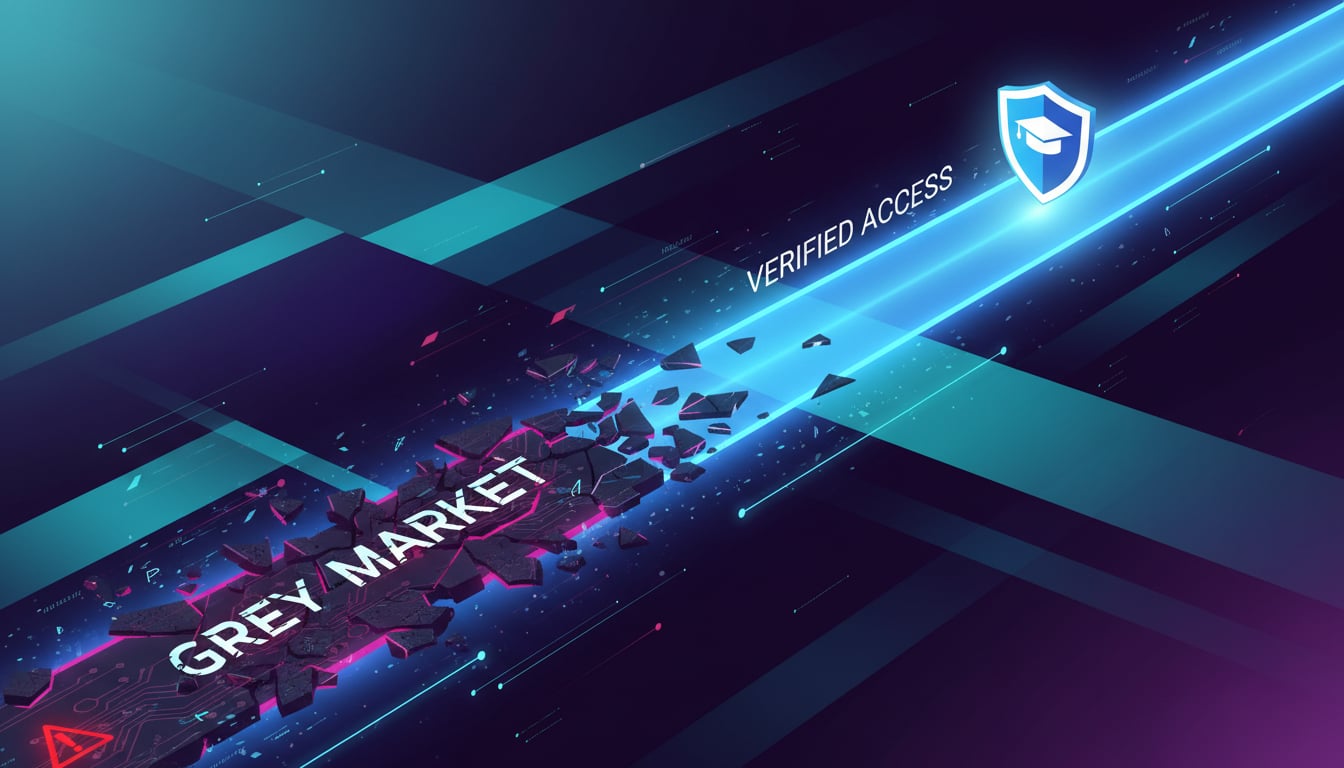
| Grey Market Methods (e.g.account sharing) | High | Varies / Hidden | Account bans, data theft, unreliable access |
| StudentPrice.deals Verification | Low | One-time fee | Secure, guaranteed 12-month access, legit verification |
Let me do the math for you. The Total Access Package is $80. Let’s look at the annual retail cost for just a few of these services:
- YouTube Premium: ~$168/year
- Spotify Premium: ~$132/year
- Perplexity Pro: ~$200/year
- Gemini Advanced (Google One AI Premium): ~$240/year
That’s over $700 in value. Paying a one-time $80 verification fee to save over $600 isn’t a shady loophole, it’s just smart money management. The process is straightforward and explained in the step-by-step SharedID guide. You’re not buying a stolen account; you’re paying for access to a verification method that unlocks cheap premium subscriptions for students and learners.
I was a skeptic, but the math and the logic checked out. You’re not stealing. You’re paying for a key to a door that companies are happy to let you open because they want you inside. The objection I had completely dissolved.

The Smartest Move: Turn Your Savings into Passive Income
Okay, so after my journey from skeptic to believer, I found something even better. Once you realize how much value you’re getting, telling your friends is a no-brainer. And that’s where the smartest play comes in: the StudentPrice.deals referral program. It’s not some measly 10% coupon; it’s a massive 50% commission on every single sale.
This isn’t just about saving money anymore, it’s a legitimate way to earn money online. If you refer two friends who buy the $80 Total Access Package, you make $80 ($40 x 2). You’ve instantly paid for your own package and are now in pure profit mode. For a student, this is one of the easiest side hustles out there. It’s not affiliate marketing for beginners, it’s just sharing a genuinely good deal with people who will thank you for it. This final piece of the puzzle is what really convinced me that this entire ecosystem is designed to benefit savvy consumers.
It’s like a free sample at Costco. They know not every person who tries the mini sausage will buy a 5lb pack, but it builds goodwill and gets people hooked on the product. Companies factor this into their financial models. They would rather have 10 million users paying a discounted rate than 3 million users paying full price and 7 million using a free, ad-supported alternative (or worse, a competitor’s service). What they really hate is fraud. What they accept is legitimate, third-party student verification that brings them paying customers, even if those customers are just outside the traditional.edu box. You can even use our eligibility checker to see what you qualify for.
Is Using a Verification Service a Legit Student Pricing Hack?
This was the part that finally convinced me. After realizing that companies budget for this, the idea of a verification service started to make sense. (Honestly, I thought they were all scams designed to steal your info, but I was wrong). You’re not trying to fool a system; you’re paying for a legitimate service that provides you with a verified ID that satisfies the requirements for these educational discount programs. You become a verified ‘learner,’ which is a category these companies are happy to serve.
Here’s how I see the difference:
| Approach | Risk Level | Cost | Outcome |
|---|---|---|---|
| Grey Market Methods (e.g.account sharing) | High | Varies / Hidden | Account bans, data theft, unreliable access |
| StudentPrice.deals Verification | Low | One-time fee | Secure, guaranteed 12-month access, legit verification |
Let me do the math for you. The Total Access Package is $80. Let’s look at the annual retail cost for just a few of these services:
- YouTube Premium: ~$168/year
- Spotify Premium: ~$132/year
- Perplexity Pro: ~$200/year
- Gemini Advanced (Google One AI Premium): ~$240/year
That’s over $700 in value. Paying a one-time $80 verification fee to save over $600 isn’t a shady loophole, it’s just smart money management. The process is straightforward and explained in the step-by-step SharedID guide. You’re not buying a stolen account; you’re paying for access to a verification method that unlocks cheap premium subscriptions for students and learners.
I was a skeptic, but the math and the logic checked out. You’re not stealing. You’re paying for a key to a door that companies are happy to let you open because they want you inside. The objection I had completely dissolved.
The Smartest Move: Turn Your Savings into Passive Income
Okay, so after my journey from skeptic to believer, I found something even better. Once you realize how much value you’re getting, telling your friends is a no-brainer. And that’s where the smartest play comes in: the StudentPrice.deals referral program. It’s not some measly 10% coupon; it’s a massive 50% commission on every single sale.
This isn’t just about saving money anymore, it’s a legitimate way to earn money online. If you refer two friends who buy the $80 Total Access Package, you make $80 ($40 x 2). You’ve instantly paid for your own package and are now in pure profit mode. For a student, this is one of the easiest side hustles out there. It’s not affiliate marketing for beginners, it’s just sharing a genuinely good deal with people who will thank you for it. This final piece of the puzzle is what really convinced me that this entire ecosystem is designed to benefit savvy consumers.